

Infrastructure delivery is not only an Engineering challenge. It is a Collaboration challenge.

The final day of ADIS 2026 brought the infrastructure discussion back to where major projects ultimately succeed or fail : execution.
After two days focused on vision, investment, urban transformation, innovation, and partnerships, the FIDIC Conference & Workshop shifted the discussion toward the practical mechanics of delivery: procurement strategy, contract models, risk allocation, variations, claims, notices, real-time records, and dispute avoidance.
That transition matters.
Infrastructure ambition is necessary. Capital is necessary. Engineering capability is necessary. But none of these alone guarantees delivery performance.
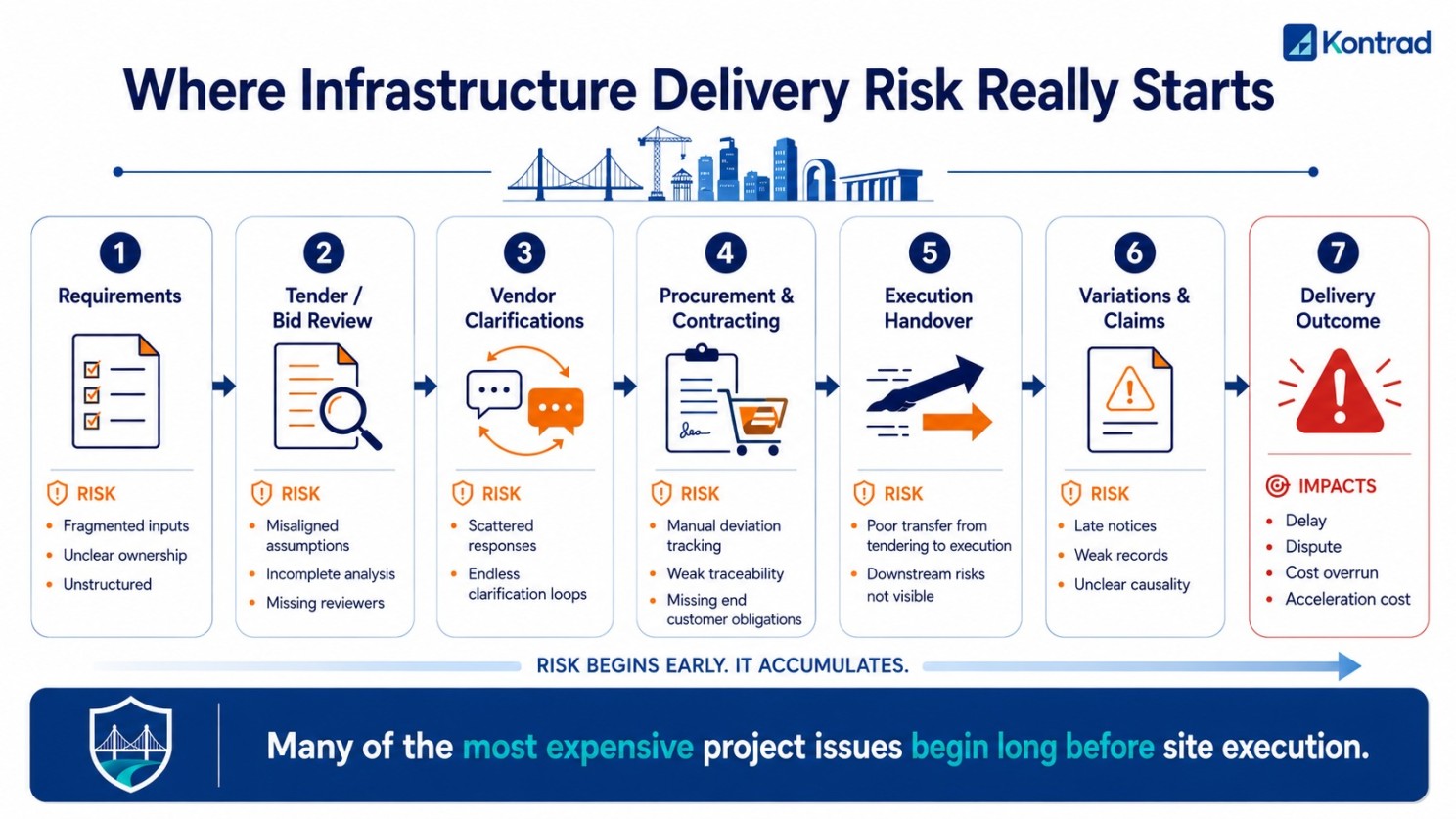
In large infrastructure programs, value is often lost in the space between strategy and execution: fragmented requirements, unclear responsibilities, scattered vendor clarifications, late commercial deviations, weak record-keeping, and poor handover from tendering to project delivery.
This is where many delays, claims, disputes, and cost leakages begin.
The numbers are difficult to ignore
The global data on large projects remains challenging.
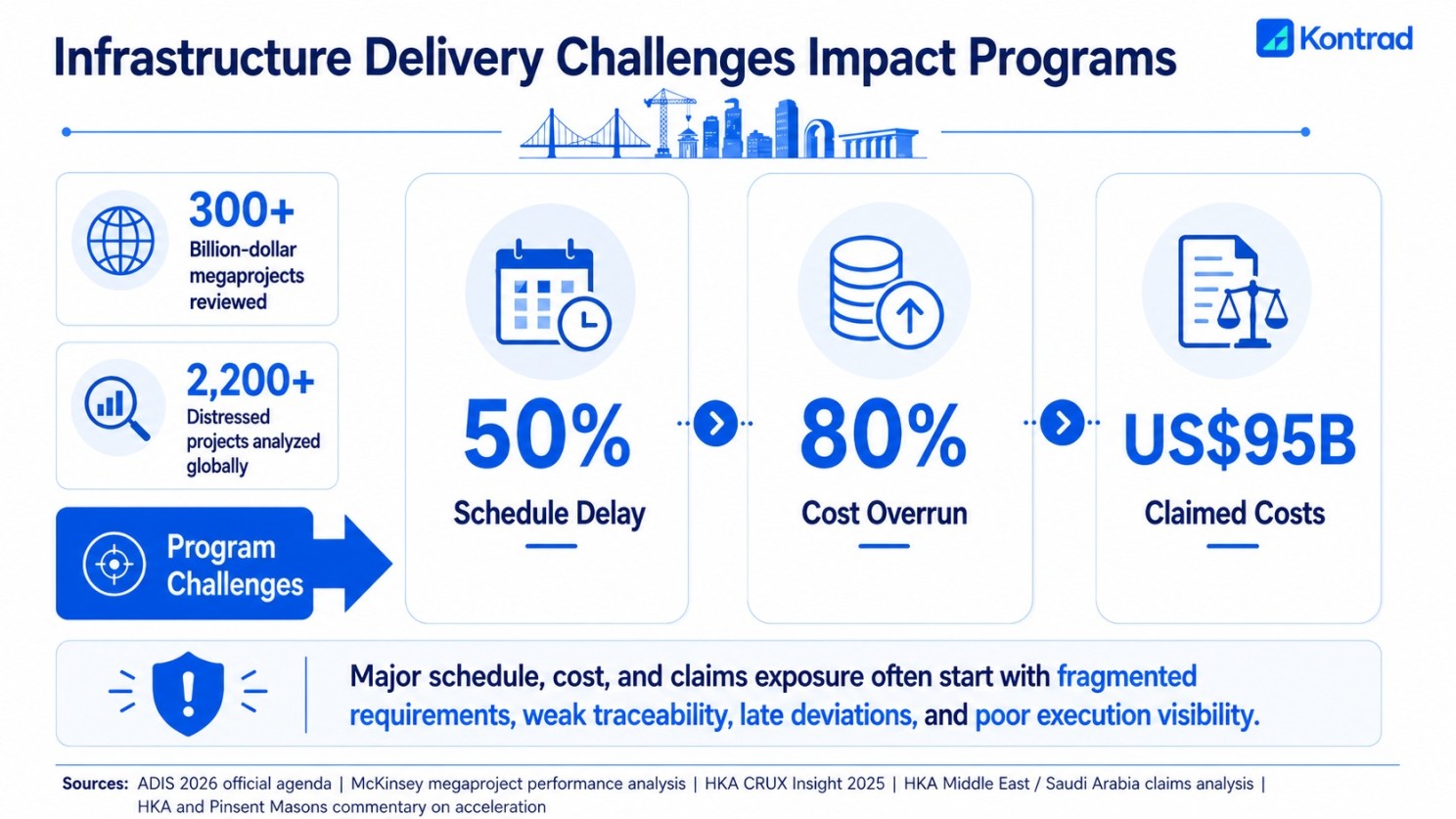
McKinsey’s review of more than 300 billion-dollar-plus megaprojects showed average cost overruns of approximately 80% and schedule delays of about 50%. HKA’s 2025 CRUX Insight report, based on more than 2,200 distressed projects worldwide with a combined value of approximately US$2.43 trillions, reported US$95 billion in claimed costs, with sums in dispute averaging 33.4% of contract budgets and time extensions averaging 65.8% of planned schedules.
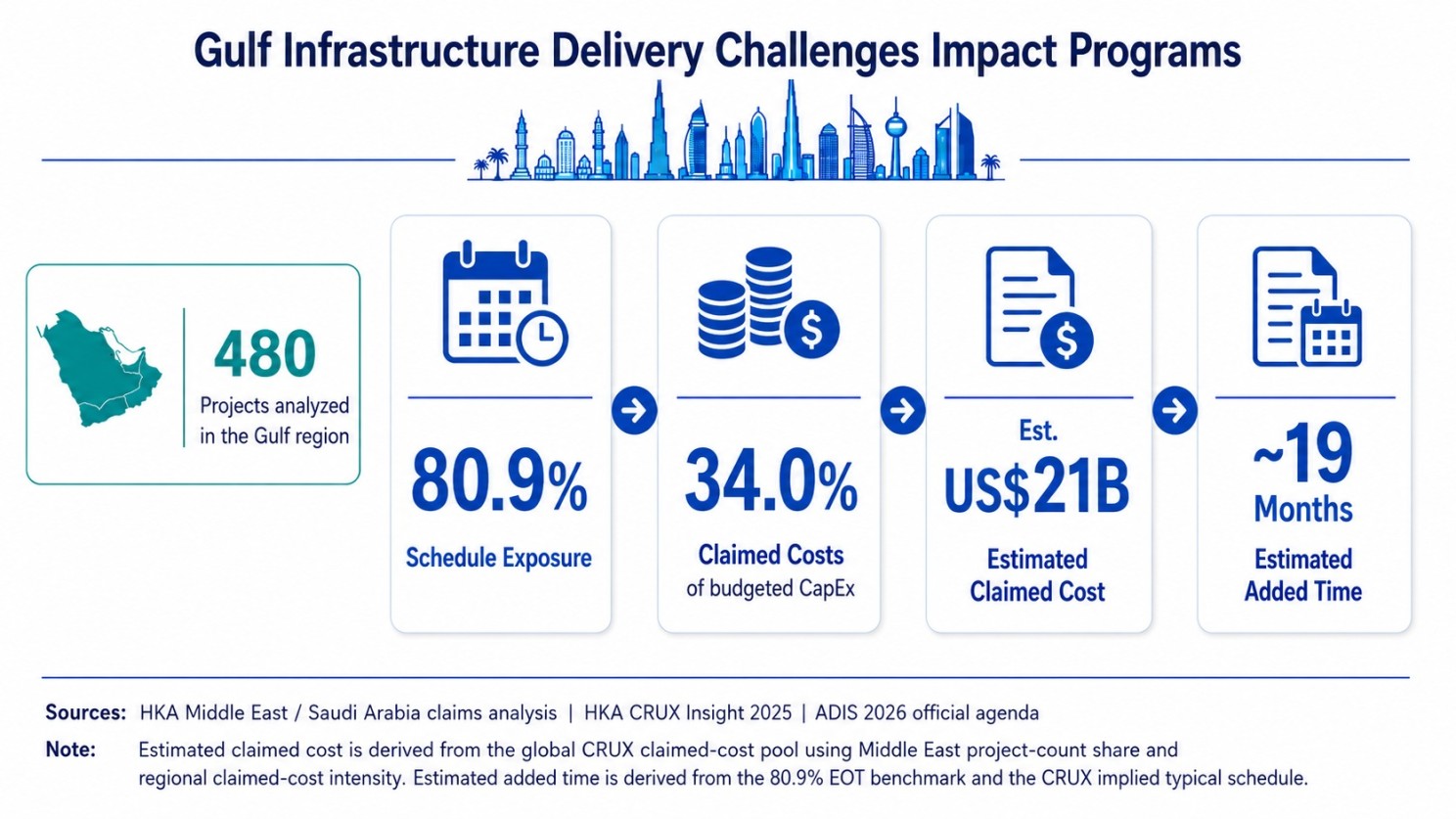
The Middle East context is also particularly relevant. HKA’s regional analysis of Middle East projects reported claimed extensions of time averaging 80.9% of planned schedules, with claimed costs around 34% of budgeted CapEx. In Saudi Arabia, HKA-linked 2026 commentary reported an even sharper schedule exposure, with extension-of-time claims around 96.2% of planned duration on the projects assessed.
These figures are not just statistics. They represent delayed assets, trapped capital, margin erosion, management distraction, legal exposure, strained partnerships, and reputational risk.
And often, the root causes are not purely technical.
They are linked to how organizations collaborate, document, decide, escalate, and transfer knowledge across the project lifecycle.
The hidden cost of “still being on track”
There is another issue that is often less visible.
A project can appear “on track” at executive reporting level while already accumulating hidden cost below the surface.
This happens when teams protect milestones through costly recovery measures: overtime, additional shifts, resequencing, expedited procurement, premium logistics, additional subcontractors, extra supervision, and unplanned acceleration plans.
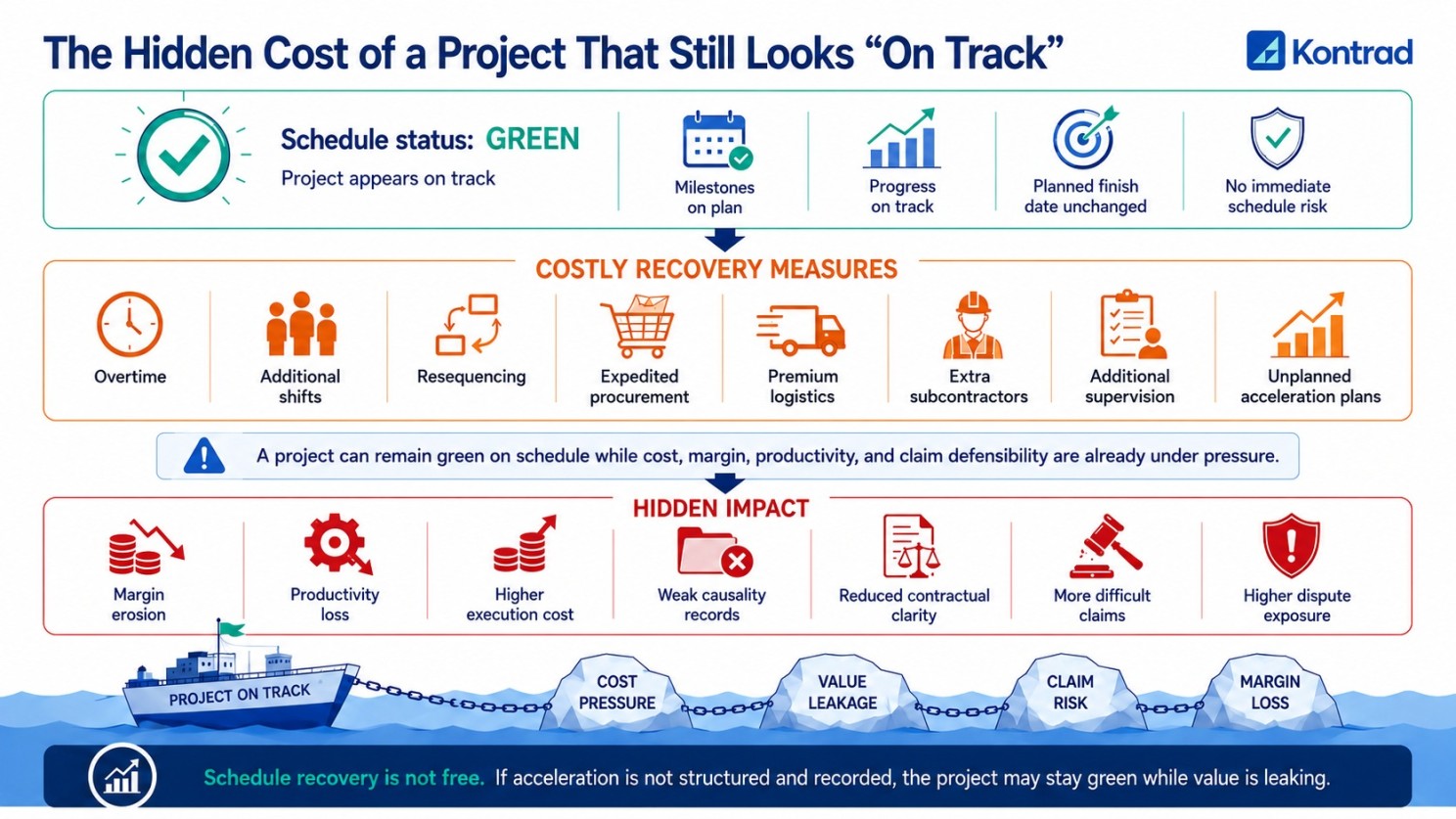
From a schedule dashboard perspective, the project may still look green.
But commercially, the situation may already be deteriorating.
Margins are being consumed. Productivity may be dropping. Contractual clarity may be weakening. The causality between delay, disruption, acceleration, and cost may not be properly recorded. And when the issue finally escalates, it becomes difficult to reconstruct who decided what, when, based on which information, and with which contractual implication.
This is why real-time records, structured traceability, and disciplined collaboration are not administrative details. They are strategic risk controls.
Why FIDIC topics are execution topics, not only legal topics
The FIDIC themes discussed at ADIS — variations, claims, notices, risk allocation, contract administration, dispute avoidance, and DAAB mechanisms — are sometimes perceived as legal or contractual matters.
In reality, they are execution performance topics.
A variation is rarely just a contractual instruction. It can affect design, procurement, planning, cost, supplier commitments, site sequencing, cash-flow, and downstream claims.
A late clarification is rarely just an email. It can create misalignment between commercial assumptions, engineering interpretation, supplier scope, and execution commitments.
A missed notice is rarely just a procedural failure. It can compromise entitlement, weaken claim defensibility, and shift financial exposure.
A poorly documented decision is rarely just a governance gap. It can become a dispute months later.
This is why infrastructure delivery requires more than document storage, email threads, shared folders, and manual trackers.
It requires structured collaboration.
The real problem: fragmentation between functions
Most organizations involved in infrastructure projects are not short of expertise.
They have strong legal teams, experienced procurement professionals, capable engineers, commercial managers, project directors, planners, finance teams, and delivery leaders.
The challenge is that these teams often work in fragmented workflows.
Procurement may manage supplier clarifications separately from engineering requirements. Legal may review contractual deviations separately from commercial assumptions. Project controls may receive dependency information too late. Finance may only see cost exposure once acceleration or claims are already underway. Management may receive escalations after the opportunity to prevent the issue has passed.
The result is predictable:
- Requirements are interpreted differently by different parties.
- Vendor responses are difficult to compare.
- Clarifications are scattered across emails and spreadsheets.
- Commercial deviations are identified too late.
- Contractual obligations are not clearly connected to execution risks.
- Decisions are made without a complete view of downstream consequences.
- Handover from tendering to execution is weak.
- Claims defensibility depends on reconstructing history after the fact.
This is not only inefficient. It is expensive.
Where structured collaboration creates value
This is the problem space where platforms like Kontrad can bring tangible value.
Kontrad is designed to help organizations structure complex collaboration workflows around requirements, clarifications, deviations, obligations, risks, decisions, and execution visibility.
The objective is not simply to digitize existing processes.
The objective is to improve the way teams work together.
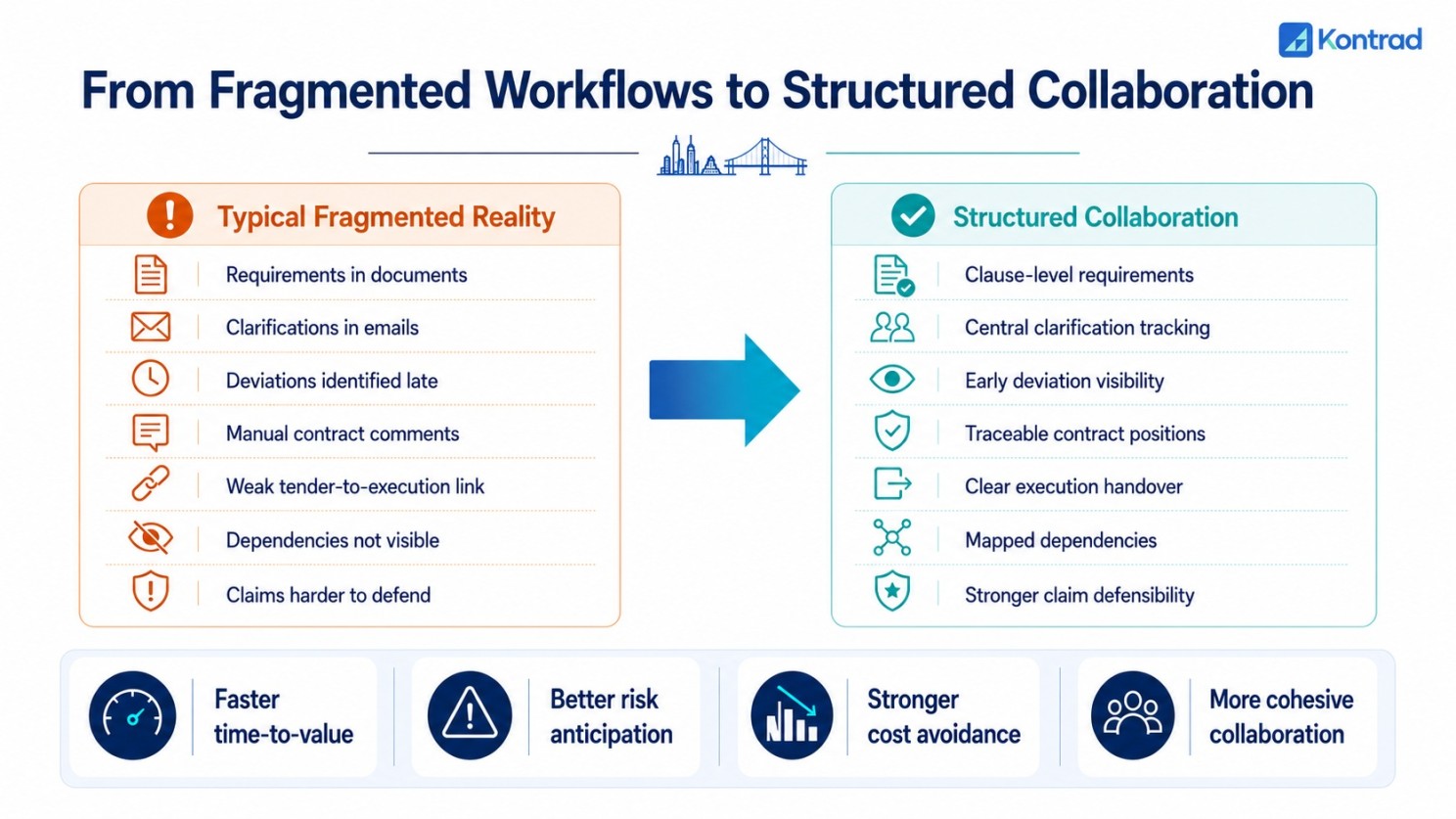
For procurement and sourcing teams, this means better structured vendor reviews, clearer comparison of responses, and fewer endless clarification loops.
For legal and contract teams, it means stronger traceability from requirement to clarification to contract position to execution record.
For commercial teams, it means earlier visibility of deviations, assumptions, and potential exposure.
For engineering teams, it means clearer requirements, better ownership of interfaces, and reduced rework from conflicting inputs.
For project delivery teams, it means better handover from tendering into execution and earlier visibility of risks and dependencies.
For finance teams, it means improved cost anticipation, stronger forecasting, and better visibility on where margin erosion may start.
For JV and consortium partners, it means a shared view of responsibilities, interfaces, risks, and decisions.
For top management, it means better governance: fewer blind spots, earlier escalation, and a more auditable decision trail.
The next performance lever in infrastructure
The future of infrastructure delivery will not only depend on what gets built.
It will depend on how well the organizations involved can collaborate across the full lifecycle: from early requirements, tendering, vendor review, procurement, contract negotiation, execution planning, variations, claims, and handover.
This is particularly important in a region where the infrastructure pipeline is ambitious, timelines are compressed, stakeholder ecosystems are complex, and public-private delivery models are expanding.
The lesson from ADIS 2026 is clear.
Infrastructure stakeholders do not only need more ambition. They need better execution discipline.
They need better ways of working.
They need tools that help teams move from fragmented information to structured decisions, from reactive claims management to proactive risk visibility, and from siloed coordination to cohesive collaboration.
That is where I believe the next wave of infrastructure performance will come from.
Not only from better engineering.
Not only from stronger contracts.
Not only from more capital.
But from the ability of all parties involved to work together.
This is the space where Kontrad is focused: helping infrastructure stakeholders bring more structure, transparency, traceability, and discipline to complex collaboration workflows.
*****
Source note: This article references publicly available materials from ADIS 2026, McKinsey, HKA, and Pinsent Masons.
ADIS materials were used for the summit and FIDIC workshop context. McKinsey’s megaproject performance analysis was used for the 300+ megaproject benchmark, including average cost overruns of approximately 80% and schedule delays of about 50%. HKA CRUX Insight 2025 was used for global claims and dispute benchmarks, including US$95.0bn in claimed costs, 33.4% average sums in dispute, and time extensions of 65.8% of planned schedules. HKA’s Middle East / Saudi Arabia analysis was used for the regional EOT and claimed-cost benchmarks. HKA and Pinsent Masons commentary was used for the discussion on acceleration measures such as resequencing, overtime, shift work, and additional resources.
#ADIS2026 #AbuDhabiInfrastructureSummit #Infrastructure #ProjectDelivery #FIDIC #Procurement #ContractManagement #ClaimsManagement #RiskManagement #CollaborationTools #Kontrad
